 SENAPREP
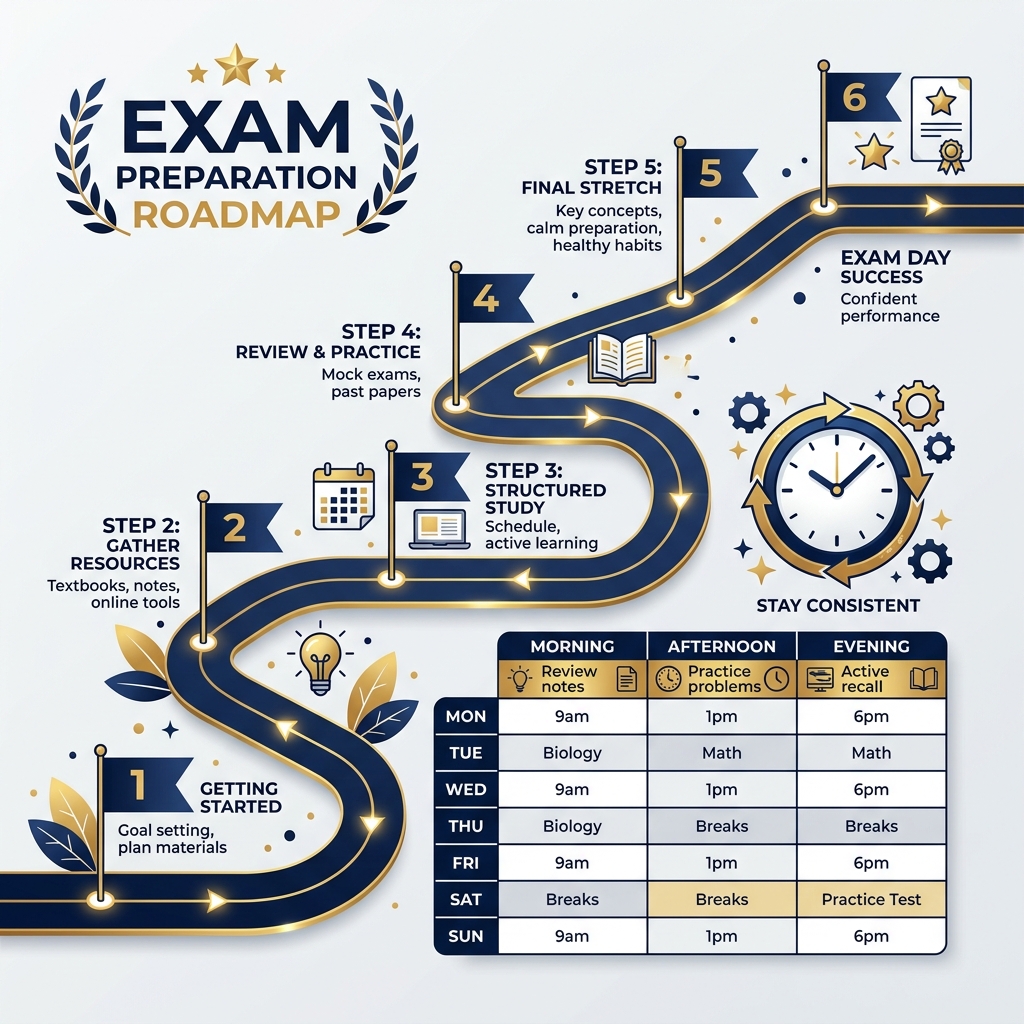
Preparing for the National Defence Academy (NDA) entrance examination is not merely an academic exercise; it is an initiation into the discipline, time management, and resilience required of future officers in the Indian Armed Forces. With over 3 lakh young aspirants competing for less than 400 seats at Khadakwasla, raw hard work without strategic direction leads to disappointment. Consult our master NDA Syllabus & Weightage Guide to align your subject priorities.
In this master roadmap, our panel of defence educators, veteran mentors, and recent NDA toppers break down the exact phase-by-phase framework, daily schedules, subject-specific hacks, and mock test analysis models that turn candidates into commissioned cadets.
The Officer Mindset: Precision Over Volume
The NDA written exam does not reward candidates who attempt 100% of the questions with mediocre accuracy. Out of 900 total marks, scoring 400–430 marks places you in the top 2% of the nation. The key is mastering high-confidence topic clusters from the Question Bank, maintaining ruthless speed, and aggressively protecting your score from negative marking.
1. Phase-by-Phase Preparation Framework
Whether you have 12 months or 4 months, your preparation must progress sequentially through four distinct operational phases:
| Phase | Timeline Focus | Primary Objective | Key Deliverables |
|---|---|---|---|
| Phase 1: Foundation Drill | Weeks 1 – 8 | Mastering fundamental concepts from standard textbooks | Complete NCERT Class 11/12 Maths theory; read Class 9/10 NCERT Science; create a handwritten Formula Diary; master 50 core English grammar rules. Review the Best Books for NDA. |
| Phase 2: Tactical Chapter Mastery | Weeks 9 – 16 | Speed enhancement & shortcut techniques | Solve 100+ MCQs per chapter on NDA Question Bank; master value-substitution and option-elimination tricks; daily 30-word vocabulary building; practice map-based Geography. |
| Phase 3: Authentic PYQ Marathon | Weeks 17 – 22 | Pattern calibration & error diagnosis | Solve the last 10 years of authentic UPSC NDA I & II papers on our Solved PYQ Portal under strict 150-minute exam conditions; maintain an Error Logbook. |
| Phase 4: Full Battle Simulation | Weeks 23 – 24 | Peak exam temperament & speed optimization | Take 2 full-length mocks weekly on NDA Mock Tests; revise formulas daily; review current affairs digest on Current Affairs Hub; calibrate physical stamina for SSB Interview. |
2. Subject-by-Subject Tactical Attack Plan
A. Mathematics (Paper 1 - 300 Marks | 120 Questions)
Mathematics is the gatekeeper paper. If you fail to score the mandatory 25% (75 marks), your GAT paper will not even be evaluated. Explore our Mathematics Preparation Hub to score 130+ marks:
- The 70-Question Rule: Attempting 70 to 80 high-confidence questions with 90% accuracy yields $75 \times 2.5 = 187.5$ marks, minus a tiny penalty, leaving you safely at 160+ marks. Do not gamble on uncertain questions.
- The Golden Topic Clusters: Begin your preparation with Trigonometry (18 Qs), Matrices & Determinants (10 Qs), Quadratic Equations & Complex Numbers (12 Qs), 2D Coordinate Geometry (12 Qs), and Vector Algebra & 3D (15 Qs). These topics require shorter calculations and guarantee 65+ questions.
- Master Value Substitution: For trigonometric equations and algebraic identities, substitute standard test angles ($\theta = 0^\circ, 30^\circ, 45^\circ, 90^\circ$) or small integers ($n = 1, 2$) to eliminate 3 out of 4 options in under 20 seconds.
- Daily Formula Blitz: Dedicate the first 20 minutes of every morning to writing down 30 formulas from memory into your Formula Notebook.
B. English (GAT Part A - 200 Marks | 50 Questions)
English is the highest return-on-investment section of the entire exam. With no heavy calculations, you can easily secure 160+ marks in 35 minutes via our NDA English Hub:
- Root Word Methodology: Learn Greek and Latin root words (e.g., Mal- = bad, Bene- = good, Omni- = all, Chron- = time). This enables you to deduce the meaning of unfamiliar vocabulary instantly in Synonyms and Antonyms.
- The 30 Golden Grammar Rules: Master Subject-Verb Agreement, Prepositional Collocations, Conditionals, and Inversion rules tested extensively in Spotting Errors.
- PQRS Jumbled Ordering: Look for introductory noun statements to identify the opening sentence, followed by relative pronouns, transitions (however, therefore), and chronological time markers.
C. General Science: Physics, Chemistry & Biology (200 Marks)
General Science accounts for 50 questions. UPSC focuses on conceptual applications rather than complex numerical derivations:
- Physics (100 Marks): Master Ray Optics (image formation by mirrors/lenses, refractive index), Newton's Laws & Momentum, Work-Energy Theorem, Ohm's Law & Circuits, and Sound wave frequencies.
- Chemistry (60 Marks): Focus on everyday chemical compounds (Acids, Bases & Salts like Baking soda $\text{NaHCO}_3$, Plaster of Paris $\text{CaSO}_4\cdot \frac{1}{2}\text{H}_2\text{O}$), pH scale indicators, Redox Reactions, and Carbon Allotropes.
- Biology (40 Marks): Concentrate on Cell Organelles (Mitochondria, Chloroplasts), Human Organ Systems, and Vitamin deficiency charts.
D. Social Sciences & Current Affairs (200 Marks)
- Modern Indian History: Create chronological timeline charts from the 1857 Revolt to the Freedom Movement, Partition of Bengal, and Quit India Movement.
- Geography: Study Indian Geography & Rivers—Himalayan mountain passes, drainage systems of Indus, Ganga, Brahmaputra, and Godavari, and Atmospheric Climate Belts.
- Indian Polity: Thoroughly memorize Fundamental Rights (Articles 12–35) & Duties (Article 51A), Directive Principles, and the powers of the President and Parliament.
- Current Affairs: Review the last 6 months of Defence News, Joint Exercises & Acquisitions on the SenaPrep Current Affairs Hub.
3. Master Daily Timetable for NDA Aspirants
A disciplined daily routine balances rigorous academics with the physical conditioning required for the SSB Interview:
| Time Slot | Dedicated Activity | Focus & Objective |
|---|---|---|
| 05:30 AM – 06:45 AM | Physical Training & Running | 2.5 km run, push-ups, pull-ups, squats (Builds stamina for SSB GTO tasks). |
| 07:15 AM – 08:00 AM | Daily Current Affairs & Editorial | Read national defence news and 20 vocabulary flashcards on Current Affairs. |
| 08:30 AM – 11:30 AM | Mathematics Core Session (Block 1) | Theory study, solved examples, and 40 practice problems on high-yield Mathematics chapters. |
| 11:45 AM – 01:15 PM | English Grammar & Vocabulary (Block 2) | Grammar rule drills on Spotting Errors and Synonyms. |
| 01:15 PM – 02:30 PM | Lunch & Rest / Power Nap | Mental relaxation and physical recovery. |
| 02:30 PM – 05:00 PM | General Science: Physics / Chemistry (Block 3) | NCERT line-by-line reading and concept solving on Physics and Chemistry. |
| 05:30 PM – 07:00 PM | History, Geography & Polity (Block 4) | Timeline review on History and map drills on Geography. |
| 08:00 PM – 09:30 PM | Timed Quiz Practice on SenaPrep App | Solve 50 chapter-wise MCQs on the Question Bank; analyze mistakes and AI explanations. |
| 09:30 PM – 10:15 PM | Formula Diary Review & Day Planning | Revise formula notebook, log daily accuracy metrics, and plan next day goals. |
| 10:30 PM | Sleep (7 Hours Mandatory) | Crucial for memory consolidation and neural recovery. |
4. The Error Logbook System: Turning Mistakes into Marks
Toppers do not simply take mock tests; they analyze them ruthlessly. After every test series on Solved PYQs, categorize every wrong or skipped question into three buckets:
- Type A: Conceptual Blind Spot: You did not know the formula or theory. Remedy: Re-read the chapter in NCERT or view the topic notes on SenaPrep, and solve 10 similar problems on Question Bank immediately.
- Type B: Calculation / Silly Error: You knew the method but made a sign error, algebra slip, or read the question incorrectly. Remedy: Write down the exact mistake in your Error Logbook and highlight it in red.
- Type C: Time Management Trap: You spent 4+ minutes wrestling with a lengthy problem and missed 3 easy questions at the end of the paper. Remedy: Practice the "2-Minute Skip Rule"—if you don't see the clear path to solution in 60 seconds, skip and circle it for Round 3.
Track Your Real-Time Accuracy on SenaPrep
Get detailed sectional accuracy reports, topic-level percentile rankings, and AI-driven weak area remediation directly on your Android phone. Explore our Membership Plans for unlimited access.
Install Free SenaPrep Android App